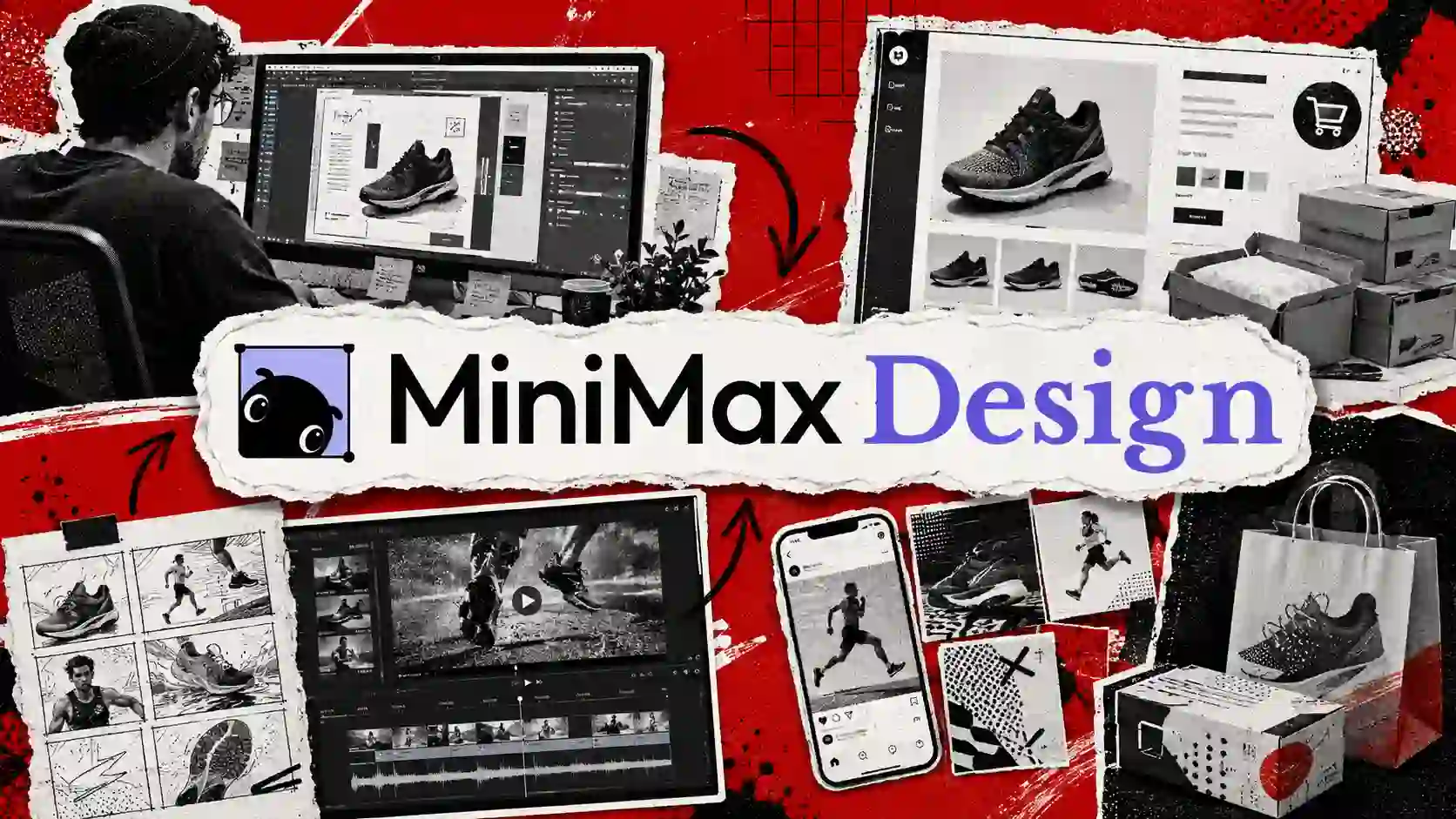
AI video creation is moving beyond the familiar prompt → generate → retry loop.
MiniMax Design introduces a more connected approach: understand the creative goal first, organize the project assets, plan the production steps, and then use MiniMax H3 for video generation, reference control, and editing.
For H3 creators, the important change is not a new video model. It is a new way to turn prompts, images, videos, audio, and project context into a structured AI video workflow.
TL;DR: What Does MiniMax Design Mean for H3 Creators?
H3 creates the video. Design organizes the workflow around it.
Prompts are becoming projects. AI workflows increasingly need to understand characters, scenes, references, revisions, and creative goals together.
Editing is becoming semantic. Instead of controlling every low-level change, creators describe what should stay, change, or improve.
Planning happens before generation. Design can organize references, shots, and 3D previsualization before H3 produces the footage.
You can still start directly with H3. MiniMaxH3.org already supports text generation, first/last-frame video, multimodal references, and 2K output.
MiniMax Design is not a new model and is not available directly on this site. However, many of the underlying MiniMax H3 video-generation workflows can already be used here.
What is MiniMax Design?
From creative intent to production workflow.
MiniMax Design is designed to turn a creative request into a sequence of production decisions.
Instead of asking users to manually manage every step, the system can interpret the goal, break it into smaller tasks, select the appropriate models and Skills, prepare media assets, generate or revise content, and continue toward a finished deliverable.
A simplified workflow looks like this:
Creative Brief
Understand the Goal
Plan the Task
Prepare References
Generate With H3
Edit and Revise
Assemble the Final Content
That distinction is important.
MiniMax H3 focuses on questions such as:
How should this shot be generated, referenced, or edited?
MiniMax Design operates at a broader level:
What needs to happen across the whole project to produce the final content?
For creators, marketers, designers, and production teams, this points toward a more agentic AI video production workflow, where generation becomes one stage rather than the entire process.
MiniMax H3 Powers the Video Layer
Design plans the task. H3 creates the video.
MiniMax Design is built around H3 and incorporates an understanding of its inputs, capabilities, reference methods, and generation workflow.
For a complex production task, the system can determine:
Which image should define a character
Which video should provide motion or camera behavior
Which audio should guide rhythm or performance
Which visual details must remain consistent
Which elements should be changed
How the final request should be converted into H3-ready instructions
This is also a useful way to think about MiniMax H3 reference-to-video, even without an AI agent.
Instead of uploading assets randomly, assign each reference a clear purpose:
Image → Character or Product Identity
Video → Motion or Camera Reference
Audio → Rhythm or Performance Context
Prompt → Creative Direction
MiniMax H3 already supports mixed image, video, and audio references, making this type of multimodal AI video workflow practical even before project-level agent orchestration is added.
Try MiniMax H3 Video Generator
From Pixel Editing to Semantic Video Creation
Describe the intent, not every edit.
Traditional editing asks creators to control individual operations:
Which clip changes
Where a cut happens
Which object moves
Which layer is replaced
When an effect begins
How a transition behaves
MiniMax's broader AI creation direction moves toward semantic video editing.
Instead of describing every technical operation, users communicate the result they want:
Keep this character.
Replace the environment.
Preserve the motion.
Make the camera more cinematic.
The system then interprets that intent across generation, modification, restructuring, or editing.
For MiniMax H3 creators, that changes what good prompting looks like.
The useful questions become:
What must stay the same?
What should change?
What should the final shot accomplish?
These principles are already visible in H3 reference-to-video, video-to-video, motion transfer, and video editing workflows.
Project Context Matters More Than One Perfect Prompt
From one prompt to the whole project.
H3 already works with multimodal context across text, images, video, and audio.
MiniMax Design extends that idea by treating the entire creative project as context.
MiniMax project context may include:
Scripts
Characters
Locations
Props
Reference images
Video clips
Audio
Brand assets
Previous versions
Revision history
Ongoing conversations
Style preferences
The key improvement is not simply giving the AI more material.
It is helping the system understand how those assets relate to one another.
Consider a product campaign:
Product images define appearance.
Style references define the visual language.
Motion clips define movement.
Music defines rhythm.
The script defines the message.
A useful AI production system should understand that these are parts of one goal rather than unrelated uploads.
That is also why MiniMax H3 multimodal reference generation matters today: reference assets already let creators reduce how much the model needs to guess.
Try MiniMax H3 Reference-to-Video
MiniMax Design Organizes MV, PV, and Creative Video Production
Story first. References second. Generation follows.
For PV, MV, and other creative video projects, MiniMax Design can analyze the theme, music rhythm, and available references before defining the visual direction and storyboard.
A simplified workflow is:
Theme
→ Music and Creative Direction
→ Storyboard
→ Character / Scene / Motion References
→ H3 Shots
→ Editing
The same logic is useful even without MiniMax Design.
Instead of asking one oversized prompt to produce an entire AI music video, creators can divide the project into controlled shots:
Chorus Performance
→ Close-Up
→ Motion Shot
→ Transition
→ Final Hero Shot
This shot-based approach also works well for:
AI product ads
Game trailers
Fashion videos
Character promos
Cinematic concept videos
Social media campaigns
A stronger production usually comes from planning several usable H3 shots, not asking one generation to solve the entire project.
Read MiniMax H3 Music Video Guide
MiniMax Design Targets Multi-Step Commercial Workflows
One brief can become an entire content pipeline.
Commercial content rarely ends with a single generated clip.
Brands may need:
Multiple opening hooks
Different product benefits
Audience-specific versions
Vertical and landscape formats
Alternative creative concepts
Updated captions
New scenes
Revised product assets
MiniMax Design is aimed at these multi-step AI content production workflows, where generation, revision, and asset organization need to remain connected.
Its official examples include KOC and UGC content, brand shorts, product marketing, educational video, PV/MV production, movie titles, VFX packaging, and character promotional content.
A full agent workflow can help coordinate those stages.
But creators who already know which shot they need may not require the entire system.
MiniMax H3 can still be used directly for ecommerce videos, product marketing, social content, game concepts, previsualization, and motion-driven creative work through text, frame-based, and multimodal reference generation.
3D Director Adds Previsualization Before H3 Generation
Previsualize first. Generate with more control.
For scenes that require tighter staging, MiniMax Design introduces a 3D Director workflow.
Creators can describe:
The scene
Character actions
Camera requirements
They can then arrange characters in 3D space, adjust poses and camera positions, and inspect the composition from different viewpoints before sending the setup into the H3 generation workflow.
The key idea is AI video previsualization.
Instead of repeatedly generating until the framing happens to work:
Place → Pose → Frame → Check → Generate
Part of the trial-and-error process happens before rendering the final video.
MiniMax H3 creators can use the same principle even without the 3D Director.
Prepare stronger:
Starting frames
Ending frames
Character sheets
Scene references
Motion references
before generation.
This is particularly useful with H3 first-and-last-frame video generation and multimodal reference workflows, where stronger inputs can create clearer constraints.
What Can You Already Do With MiniMax H3?
Start with H3 now. Add the larger workflow when you need it.
MiniMax Design adds planning and orchestration, but many of the generation capabilities underneath that workflow are already directly useful to H3 creators.
Workflow | |
Text-to-video | Available |
Image-to-video | Available |
First / last frame control | Available |
Image references | Available |
Video references | Available |
Audio references | Available |
Mixed multimodal references | Available |
2K video generation | Available |
5–15 second video output | Available |
Agent project planning | Not currently offered |
3D Director | Not currently offered |
The distinction is simple.
If your problem is:
“I already know the shot I want. I need H3 to generate it.”
you can start directly with the MiniMax H3 generator.
Generate a 2K MiniMax H3 Video
From Generation Tool to Production System
MiniMax Design points to three broader changes in AI video creation.
1. Prompts Will Become Creative Briefs
Creators will increasingly communicate intent, priorities, constraints, and desired outcomes instead of mechanically describing every visual detail.
2. References Will Become Project Assets
A character image, product photo, motion clip, soundtrack, or environment reference will become part of a larger creative context rather than an isolated upload.
3. Generation Will Become One Step in a Loop
The workflow shifts toward:
Plan → Generate → Review → Modify → Assemble
instead of:
Generate → Start Over
That direction fits naturally with H3's multimodal approach to reference-based AI video generation and video editing.
For creators, the lesson is straightforward:
Spend less time chasing one perfect prompt.
Spend more time defining what the project needs.
MiniMax Design shows where H3 production is heading: better planning, richer context, and more connected workflows.
But you do not need a complete AI agent system to start creating useful H3 videos.
Choose the workflow that matches the task:
Use text-to-video when you want to start from an idea.
Use image-to-video when one visual already defines the scene.
Use first and last frames when the beginning and ending need tighter control.
Use image, video, or audio references when identity, motion, camera behavior, style, or rhythm needs to stay consistent.
Build one strong shot at a time before expanding into a larger production.
The practical workflow is simple:
Define what matters → Choose the right reference → Generate the shot.
MiniMax Design FAQs
How Is MiniMax Design Different From MiniMax H3?
MiniMax H3 is the multimodal video model, while MiniMax Design is a separate agent-driven creative workflow layer that organizes H3 and other production capabilities around a larger task.
Can I Use MiniMax Design on MiniMaxH3.org?
No. MiniMaxH3.org does not currently include MiniMax Design.
The site is focused on direct H3 video generation, including text-based creation, frame-controlled workflows, and multimodal references.
Is MiniMax Design Required for H3 Reference-to-Video?
No. H3 reference workflows can be used independently.
OnMiniMaxH3.org, creators can work directly with supported image, video, and audio references without using the full MiniMax Design system.
How Does Semantic Video Editing Work?
Semantic video editing focuses on creative intent rather than manual operations.
Instead of defining every small edit, the creator describes what should be preserved, replaced, adjusted, or improved in natural language.
What Does Project Context Mean for AI Video?
Project context is the wider collection of information an AI can use to understand a production.
It can include scripts, characters, scenes, reference images, video clips, audio, brand assets, earlier versions, and revision history, rather than relying only on a single prompt.
Can MiniMax Design Replace a Professional Video Editor?
Not necessarily. MiniMax Design is intended to coordinate tasks such as generation, editing, subtitles, and content assembly, but the official information does not claim that it replaces every professional post-production workflow.
More complex productions may still rely on dedicated editing, compositing, or finishing tools.